



Types of Tooling Fixtures in Intelligent Manufacturing Workshops and Advantages of Electric Permanent Magnet Fixtures: Qianhao Widely Applied in Automotive Manufacturing
Data Source:
Author:
Publish Time:
2025.07.27
In intelligent manufacturing workshops, tooling fixtures are crucial equipment for achieving automated production, ensuring product quality, and enhancing overall efficiency. Different types of tooling fixtures are suited to various production scenarios, and among them, electro-permanent fixtures have gained widespread adoption in fields such as automotive manufacturing due to their unique advantages. This article will introduce the common types of tooling fixtures used in intelligent manufacturing workshops, with a particular focus on analyzing the benefits of electro-permanent fixtures, and will also detail how Qianhao’s electro-permanent fixtures are applied specifically in automotive manufacturing enterprises.
I. Common Types of Jigs and Fixtures Used in Intelligent Manufacturing Workshops
Mechanical fixture
Mechanical fixtures achieve workpiece clamping through mechanical structures and typically consist of locating elements, clamping devices, guiding components, and more. They feature a simple design, low cost, and high reliability, making them ideal for positioning and clamping workpieces with straightforward geometries and stable dimensions in mass production—such as the machining and securing of shaft-like or disc-shaped parts. However, mechanical fixtures offer limited flexibility in adjustment; when switching between different workpieces, they require reconfiguration, making it challenging to meet the demands of flexible, multi-variety, small-batch production processes.
Pneumatic fixture
Pneumatic fixtures use compressed air as a power source, employing cylinders to drive the clamping mechanism and securely hold workpieces in place. They feature fast response times, stable clamping force, and the ability to enable automated control, making them widely used in assembly line production—for processes such as drilling and milling of automotive components. However, pneumatic fixtures require a complementary air supply system and demand high stability in air pressure. Additionally, they are prone to malfunctions under harsh conditions like dust or high temperatures.
Hydraulic fixture
Hydraulic fixtures use hydraulic oil as the power transmission medium, generating substantial clamping force through hydraulic cylinders. They are ideal for securely holding large, heavy workpieces during machining processes—such as the machining of engine cylinder blocks or gearbox housings. While these fixtures deliver strong, uniform clamping forces and operate smoothly, their hydraulic systems feature a relatively complex design, leading to higher maintenance costs and an increased risk of oil leakage and contamination.
Vacuum fixture
Vacuum fixtures use a vacuum pump to remove air between the suction cup and the workpiece, leveraging atmospheric pressure to securely hold and clamp the object. They are particularly suitable for workpieces with smooth surfaces and relatively thin materials, such as glass, plastic sheets, and thin steel plates. However, vacuum fixtures demand high surface flatness on the workpiece; if sealing is inadequate, insufficient suction force may occur. Additionally, the suction cups are prone to wear and tear, requiring regular replacement.
Electro-permanent magnetic fixture
Electro-permanent fixtures operate on the principle of electromagnetism, using electrical pulses to control the magnetic state of permanent magnets, thereby enabling the clamping and releasing of workpieces. Combining the advantages of both permanent-magnet and electromagnetic fixtures, these devices maintain clamping force without continuous power supply, making them energy-efficient, highly effective, and versatile—particularly excelling in flexible production scenarios within smart manufacturing workshops.
II. Advantages of Electropermanent Fixtures
Energy-saving and efficient, reducing energy consumption
Electric permanent magnet fixtures require electricity only during the magnetization and demagnetization processes, eliminating the need for continuous power supply while clamping workpieces. This results in extremely low energy consumption, allowing significant energy savings compared to electromagnetic fixtures that demand constant power. In large-scale, intelligent manufacturing workshops, long-term use can substantially reduce a company’s energy costs.
Protect workpiece surfaces and enhance product quality.
Electro-permanent magnetic fixtures use magnetic force to securely hold workpieces, eliminating the need for mechanical clamping forces. As a result, they leave no marks, dents, or other damage on the workpiece surface—making them especially ideal for components that demand high surface precision, such as automotive sheet metal parts and intricate precision components. This unique feature reduces the need for additional surface treatment processes, thereby enhancing the overall product quality and increasing the rate of defect-free items.
No manual adjustment required—achieve automated integration.
Electric permanent magnet fixtures can achieve automated magnetization and demagnetization through a control system, seamlessly integrating with robots and automated production lines in smart manufacturing workshops—eliminating the need for manual adjustments, reducing human error, and enhancing both production efficiency and consistency. At the same time, this approach lowers workers' physical labor intensity, aligning perfectly with the growing trend toward automated production.
Adaptable to various operating conditions, highly flexible
The magnetic force of the electro-permanent fixture can be precisely controlled via electrical pulses, making it adaptable to clamping requirements for workpieces of various materials and sizes. It can stably hold both ferromagnetic materials as well as certain non-ferromagnetic materials (when treated with special processes). Moreover, this fixture maintains reliable performance even in harsh environments such as high temperatures, dusty conditions, and humidity, making it suitable for a wide range of applications.
Safe and reliable, with high stability
Electric permanent magnet fixtures can maintain strong magnetic force even when power is lost, eliminating the safety risk of workpieces unexpectedly falling off due to sudden power interruptions. This makes them significantly safer than pneumatic, hydraulic, or electromagnetic fixtures that rely on continuous power sources. Additionally, their simple design results in lower failure rates and relatively low maintenance costs.
III. Wide Application of Qianhao Electric Permanent Magnet Fixtures in Automotive Manufacturing Enterprises
Qianhao Electric's permanent magnet fixtures, thanks to their outstanding performance, have been widely adopted across numerous automotive manufacturers, covering multiple stages—from handling components to machining and assembly.
Automotive wheel hub handling
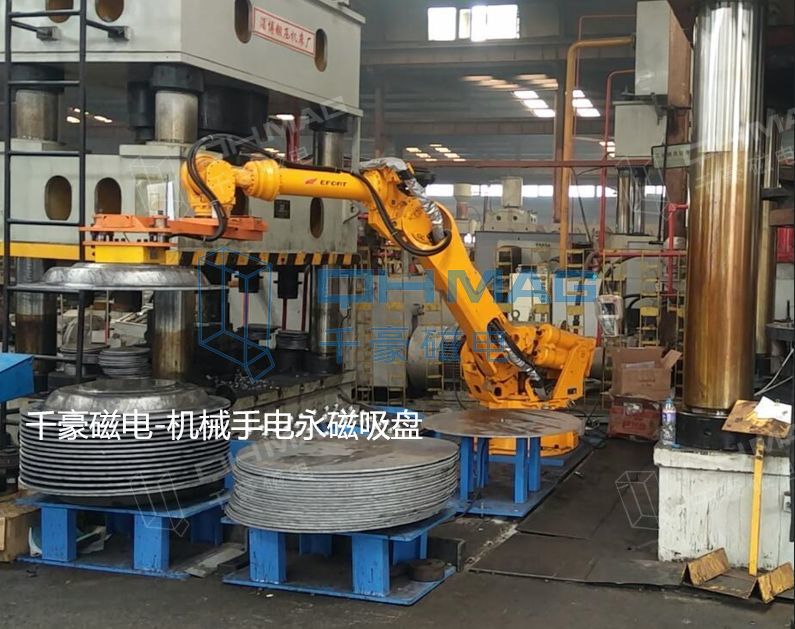
Automobile wheel hubs are typically made of aluminum alloy or steel, requiring high surface precision. Traditional mechanical fixtures, however, often cause surface scratches during handling. Qianhao’s electric permanent-magnet fixture, with its uniform magnetic force, securely holds the wheel hub in place, enabling smooth and safe transportation—from the storage area directly to the machining station or assembly line—without damaging the hub’s surface. At the same time, it facilitates rapid handling, significantly boosting the efficiency of wheel production workflows. Additionally, its advanced automation features allow seamless integration with AGV carts and robotic arms, paving the way for fully automated wheel-handling processes.
Sheet metal adsorption installation
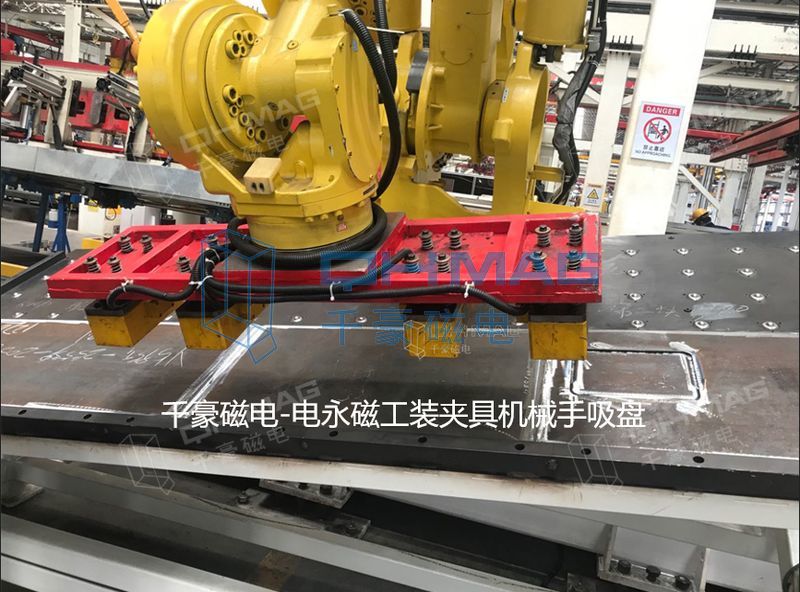
Automotive sheet metal parts are complex in shape and relatively thin, making them prone to deformation during the suction and installation process—and their surfaces must remain undamaged. Qianhao’s electro-permanent magnetic fixtures can be custom-designed with tailored magnetic circuit layouts that ensure uniform suction, effectively preventing any distortion of the sheet metal components. During automotive body assembly, these fixtures precisely hold and position the sheet metal parts at the intended locations, eliminating the need for manual adjustments and significantly enhancing both assembly accuracy and efficiency. For instance, when installing sheet metal components such as car doors or hoods, Qianhao’s electro-permanent magnetic fixtures demonstrate outstanding performance—delivering both high efficiency and reliable results.
Electro-permanent magnet for welding fixation
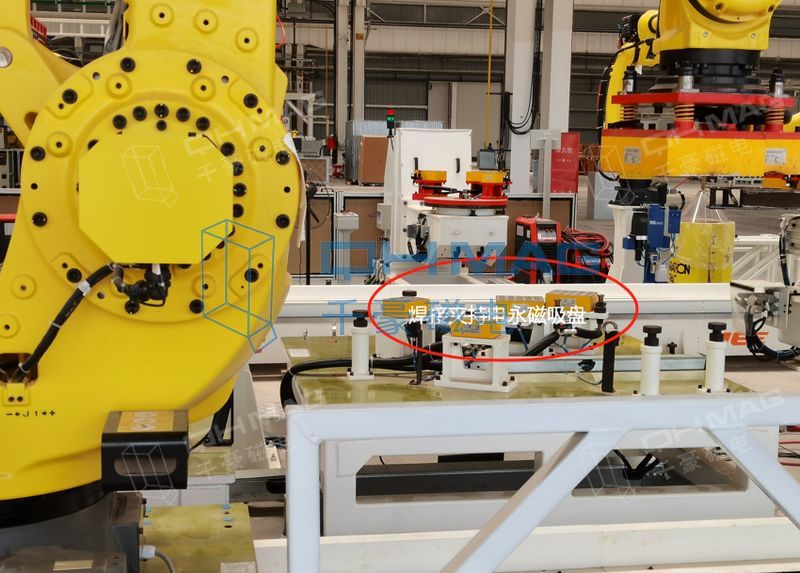
In the automotive welding process, multiple components need to be precisely fixed before welding can take place. Traditional mechanical clamping methods, however, may interfere with the welding path, and improper clamping force can easily cause deformation of the workpiece after welding. Qianhao’s electric permanent magnet welding fixture, on the other hand, uses magnetic force to securely hold the components firmly in place during welding—without occupying any additional welding space—and ensures a smooth, uninterrupted welding process. At the same time, the stable magnetic fixation minimizes movement of the workpiece during welding, significantly enhancing welding quality. After welding is complete, a reverse electric pulse quickly demagnetizes the system, making it easy to remove the workpiece and further boosting the efficiency of the welding procedure.
The widespread application of Qianhao Electric Permanent Magnet Fixtures in automotive manufacturing enterprises fully demonstrates their significant advantages in safeguarding workpieces, enhancing efficiency, and accommodating automated production—making them a key choice for many automakers looking to elevate their production standards. These fixtures have earned a solid brand reputation and enjoy broad market recognition.
In summary, intelligent manufacturing workshops boast a wide variety of tooling fixtures. Among them, electro-permanent fixtures stand out due to their energy-saving features, ability to protect workpieces, and excellent compatibility with automation systems, making them indispensable in industries such as automotive manufacturing. The successful application of Qianhao electro-permanent fixtures in scenarios like automotive wheel hub handling, sheet metal adsorption and installation, and welding fixation further underscores their practical value and promising future in the realm of intelligent manufacturing.
Recommended News
Share


Contact Us
Hunan Yueyang Liandong U Valley Industrial Park

WeChat Official Account
Friendly Links:
Copyright © Hunan Qianhao Electrical And Mechanical Technology Co., Ltd.
This site supports IPv4 IPv6 .